MGMT 6332 | Fall 2026
Strategies in Operations Management
Learn how organizations design supply chains, forecast demand, manage inventory, improve quality, and deliver products and services efficiently.
Strategies in Operations Management
Seven-week graduate course
Apply course concepts by acting as a consultant to a real organization.
Instructor
About Me
I teach this course through the lens of applied operations, analytics, technology transformation, and executive decision-making. My background is in financial services consulting, AI strategy, cybersecurity, and large-enterprise transformation.
Previous Client Experience
Education

Duke University
Master's in Quantitative Management with a focus in Business Analytics.
St. John's University
Bachelor of Science in Economics. New York.
How We Work
The course moves from concept to decision.
Each week is designed to help you understand an operating system, diagnose a real management problem, and apply the concept to a practical business decision.
Each week moves from concept to decision-making.
Online lecture
One on-campus session and two streamed online sessions.
Course at a Glance
Key dates and meeting times.
1:00-3:50 PM
1:00-3:50 PM
11:59 PM
Grading
How your grade is built.
Case Studies and Group Projects
Pick a company you can get real insights from.
The goal of the project is to act as operations consultants to apply the concepts learned in class with a real company. That lets you integrate supply chain, forecasting, inventory, capacity, quality, and project management into one executive operations strategy.
Use the same company, product, or service across the case studies when possible.
Describe the operating system before recommending improvements.
Connect each recommendation to customer value, constraints, trade-offs, or execution risk.
Write for an executive audience: clear, specific, and evidence-aware.
Homework Standards
Make your work easy to evaluate.
Strong submissions are clear, specific, and connected to the business decision in front of you.
Submit work by the stated Canvas deadline.
Use course vocabulary precisely and connect answers to the assigned scenario.
Show the logic behind calculations, assumptions, and recommendations.
Keep responses concise, professional, and decision-oriented.
Operations Basics
OM is how value gets delivered.
Operations Management is the business function that designs, manages, and improves how goods and services are created and delivered successfully to customers.
- 1Design the good, service, and process.
- 2Manage day-to-day performance.
- 3Improve quality, speed, cost, and flexibility.
- 4Make trade-offs visible before they become problems.
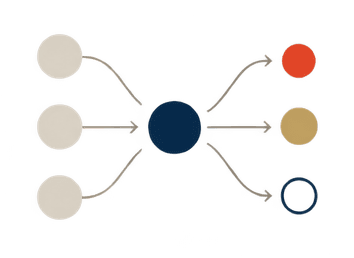
Goods, services, or both?
Operations managers need to know what they are designing and managing. Classify each example, then use the feedback to sharpen the difference between products and services.
Physical product expected to last at least three years.
Physical product consumed or replaced quickly.
Activity or experience that does not directly produce a physical product.
Process Types
Operations work shows up as goods, services, and support processes.
A business is rarely only one type of process. Most operating systems combine all three, which is why managers have to see the whole system before improving one piece.
Operations transform materials into tangible products customers can own, store, ship, or resell.
Operations design the work, people, information, and timing behind an intangible customer experience.
Operations also include planning, scheduling, data, finance, technology, and coordination processes.
Discussion Prompt
For your project company, identify one goods-producing, one service-providing, and one support process that must work together to deliver customer value.
Clients Benefit Package
Customers buy a bundle, not a process chart.
A Customer Benefits Package is the set of tangible and intangible features the customer recognizes, pays for, uses, or experiences.
Customer Value
Customers judge operations by the value they actually experience.
The manager's job is to translate internal process choices into visible customer benefits: reliability, speed, convenience, quality, flexibility, and trust.
Hint: Name the customer, the promised benefit, and the operational choice that makes it happen.
Value is designed into the system.
Value is not only marketing language. Operations choices influence what customers experience, how reliable the promise is, how fast the system responds, and what the organization must charge to sustain it.
Management insight: operations can increase value by improving benefits, reliability, or speed, but those gains often increase cost. The strategic question is which benefits the customer will recognize and pay for.
Value Chains
Value chain is the full network. Supply chain is one part of it.
Value Chain
The full network of value.
The value chain includes facilities, processes, information, services, and financial transactions that move from suppliers to customers.
Supply Chain
The movement of goods and materials.
The supply chain is the portion of the value chain focused on goods, materials, and the flows that support them.
Which statement best describes the relationship between value chains and supply chains?
Where does value get created?
A value chain is broader than the movement of goods. It includes preparation, delivery, support, information flows, and financial flows. Place each activity into the most likely stage of the chain.
Work that prepares the system to deliver value.
Work that creates or delivers the good or service.
Work that supports the customer after delivery.
Value Chain Frameworks
One simple framework: before, during, and after value creation.
Value-chain analysis becomes easier when students can locate the work: what happens before the customer buys, while value is created, and after the customer receives it.
Design, sourcing, supplier selection, contracts, financing, marketing, training, and promises made before delivery.
Process design, capacity, quality, cost, safety, productivity, and the actual good or service experience.
Installation, service, warranties, claims, maintenance, returns, consulting, and feedback loops after delivery.
Gain the customer
Create the value
Keep the customer
OM Evolution
OM evolved from efficiency management into system design under uncertainty.
Early Focus
Cost and efficiency
Standardization, scale, productivity, and repeatable work made operations measurable.
Quality Era
Consistency and reliability
Competition shifted attention toward defect reduction, process control, and customer expectations.
Modern OM
Speed, service, data, sustainability
Operations now balances analytics, resilience, customization, technology, workforce, and responsible growth.
Modern Manager's Question
How do we improve value while balancing cost, quality, speed, flexibility, resilience, sustainability, workforce capability, and technology risk?
Apply the Lens
Every operations topic is a trade-off.
What operating decision does this challenge force managers to make?
What operating decision does this challenge force managers to make?
What operating decision does this challenge force managers to make?
What operating decision does this challenge force managers to make?
What operating decision does this challenge force managers to make?
What operating decision does this challenge force managers to make?