02
MGMT 6332 / Supply Chain Design
Supply Chain Design
Map the flow of goods, services, information, suppliers, and customers.
The Management Question
How should managers design the network that moves value to customers?
What is it?
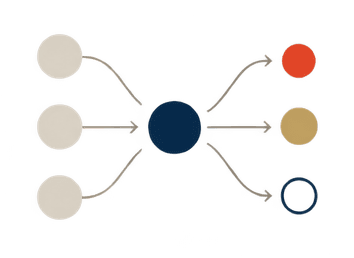
Supply chain design connects suppliers, facilities, information, transportation, and customers.
How does it work?
Choose the strategy -> decide what to own -> locate facilities -> model how product flows.
Why does it matter?
The design determines cost, speed, resilience, risk, and the promises the firm can keep.
Next step
Open the Week 2 lecture
Use the lecture to move from design choices into Excel-supported location and flow models.
Agenda - Week 02
Supply chain strategy
Efficiency, responsiveness, and trade-offs
Zara case
A responsive supply chain built around speed and feedback
Make-or-buy decisions
Break-even analysis for outsourcing choices
Location models
Factor rating and center of gravity
Transportation models
Flow decisions, constraints, and Solver setup
Learning Objectives
After this week, you will be able to:
Distinguish efficient and responsive supply-chain strategies.
Evaluate make-vs.-buy and outsourcing decisions.
Evaluate facility locations using qualitative and quantitative methods.
Calculate a center-of-gravity location.
Formulate and solve a transportation problem.
Explain how changing assumptions or constraints changes the optimal design.
Key Vocabulary6 terms - click to expand->
Supply Chain
A network of organizations, facilities, people, information, and flows that deliver value.
Responsiveness
The ability to react quickly to demand, uncertainty, and customer needs.
Outsourcing
Using an external provider to perform work the firm could potentially perform itself.
Break-Even Quantity
The volume where two alternatives have the same total cost.
Center of Gravity
A weighted-average method for estimating a location near demand points.
Transportation Model
An optimization model that assigns flows from origins to destinations while satisfying constraints.